High Tech Ready Osmium (HTRO)
High Tech Ready Osmium (HTRO)
In the high-tech world of AI, only the physical maximum counts!
Only the best counts
Osmium as a high-purity material—also known as High-Tech Ready Osmium (HTRO)—is an industrial-grade, crystalline form of osmium of the highest purity (ideally in isotopically pure form) that possesses extreme physical and quantum-mechanical properties. Notably, while it currently occupies only a niche role in the quantum computing industry due to its cost and the difficulty of processing it, early scientific data suggest that it will eventually prevail over established standard materials in specific architectures.
It is the drawbacks of potential competitors and specific physical factors that will give osmium the edge:
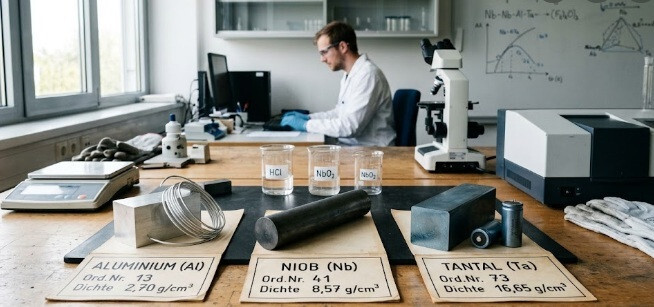
1. In competition to Niobium (Nb), tantalum (Ta) and Alloy (Al)
Application area: Superconducting qubits (such as those used by Google and IBM) and microwave resonators.
Why osmium will be superior:
o The oxide problem (TLS): The greatest enemy of coherence time (the lifespan of quantum information) in superconducting qubits is the phenomenon known as Two-Level Systems (TLS). These sources of interference arise primarily within the tiny, amorphous oxide layers on the surface of niobium or aluminum conductive traces. Tantalum has recently begun to replace niobium in cutting-edge chips because its oxide is more stable.
o The osmium solution: Solid, pure, crystalline osmium is a noble metal and is chemically extremely inert. Unlike osmium powder, it forms virtually no disruptive oxide layer at room temperature or in cryogenic vacuum conditions. At the same time, osmium becomes a superconductor at extremely low temperatures (below 0.66 Kelvin). Since superconducting quantum computers operate at approximately 0.015 Kelvin (15 millikelvin), osmium would be in a superconducting state but—due to the absence of an amorphous oxide layer—would potentially exhibit far lower dielectric losses than niobium or tantalum.
2. In competition to Gold (Au) and Copper(Cu)
Application area: Electrode materials for trapped-ion quantum computers (e.g., IonQ or Quantinuum).
Why osmium will be superior in this application as well:
o Surface stability and laser resistance: In ion traps, ions levitate in a vacuum above tiny electrodes. These electrodes (often made of gold) are irradiated with powerful lasers to control the qubits. Gold is soft; laser ablation and thermal fluctuations can cause the surface to roughen at the atomic level, leading to interfering fields ("anomalous heating").
o The osmium solution: Osmium is the densest and one of the hardest elements on Earth. It has an extremely high melting point (over 3,000°C) and one of the highest work functions of any metal. An electrode made of high-purity osmium would be extremely resistant to laser ablation, electromigration, and surface wear. It would generate a "quieter" electric field for the trapped ions.
3. Competition with light semiconductors/metals in topological qubits
Application area: Topological quantum computers (the approach pursued by Microsoft).
Why osmium will be superior here as well:
o Spin-orbit coupling: Topological qubits are based on exotic quasiparticles (Majorana fermions). Generating them requires materials with extremely strong spin-orbit coupling (the interaction between an electron's spin and its motion).
o The osmium solution: Since spin-orbit coupling increases sharply with atomic number (the size of the atomic nucleus), heavy elements like osmium (atomic number 76) offer enormous advantages in this regard. Combined with its superconductivity, pure osmium is a highly promising candidate for topological superconducting circuits.
4. Competition with natural material mixtures (isotope effects)
A specific form of osmium is produced not only chemically but also in an isotopically pure state (e.g., pure osmium-192), offering another major advantage:
Some osmium isotopes have a nuclear spin of zero. Materials with nuclear spin act like tiny magnets that interfere with the magnetic field in a quantum computer and destabilize the qubits (dephasing). A conductor made of isotopically pure osmium-192 would be completely free of magnetic nuclear spin noise.
Our conclusion and remaining hurdles
Anyone who has already purchased crystalline osmium—whether for the jewelry market or as a "generational metal"—knows that, from both theoretical and quantum-physical perspectives, it is an absolute "miracle material" for constructing quantum hardware. The reason it has not yet displaced aluminum or gold lies in practical constraints: osmium is extremely expensive; its hardness and brittleness make it difficult to deposit as a thin film onto silicon wafers or to etch; and in its oxidized powder form, it is highly toxic. However, as materials science develops methods to structure crystalline osmium safely and precisely at the chip level, it is poised to become a key material for the next generation of error-corrected quantum computers—the most powerful of their kind.
Buy HTRO in our shop and store it securely.
This website uses cookies. Here you can choose which cookies you want to accept and change your selection at any time. If you click on 'Agree', you agree to the use of cookies.
Find out more